

Since the launch of Modrinth in 2020 we can observe a particular trend. It’s getting increasingly popular, and a lot of Minecraft content creators are migrating to it or choosing to publish their content on both services. But why is CurseForge losing its userbase? Today I will try to answer that question by explaining what things Modrinth is doing better.
To be clear I will focus on my experience with those platforms as a content creator, not as a player, and only regarding Minecraft projects. If you want my analysis on the normal user experience, you can ask for it in the comments and I will do it in a different post.
To make this a bit competitive I will credit a point for everything that either platform does better than the other.
Table Of Content
- Project and file verification
- More flexibility with the project type
- Ad revenue
- Analytics functions
- Dependencies and relations
- Additional files
- Versioning and changelog
- Project Icon
- Donation options
- Comments
- Issue Tracker
- Conclusion
Project and file verification
I will start with one of the biggest issues I have with CurseForge. Both platforms require your project to be verified once you create them and that’s fine. It’s the first defense against malicious mods. But I think CurseForge is taking it a little bit too far, requiring every single file to be verified. On Modrinth – after your project is verified – your files are immediately available to public after you upload them.
That causes files to appear on the platform with a delay. Sometimes even for a few days. This is a big issue when you want to upload a hotfix to your project, as it will be under verification for more time and player will have to wait longer for an update that fixes some bugs. Being able to make your files public faster grants Modrinth the first point.
On the other hand, I must give credits where it’s due. The initial project verification is often faster on CurseForge as they – probably – have more moderators. Projects on Modrinth sometimes can be held under verification for a few days when there’s a lot of them in the queue. I must give a point to the CurseForge. So far, we have a 1 to 1 tie.
More flexibility with the project type

This one is quite important for me, as I make datapacks and later convert them to mods using the feature available on Modrinth. Modrinth allows a project to include both mods and datapack files at the same time and it will be visible under both categories.
On CurseForge your project needs to be either a mod or a datapack. If your project has both releases, you need two separate project pages, which makes it difficult to manage once you release more than a few projects. That’s another point for Modrinth.
Let’s get back to something I mentioned earlier. When you upload the datapack to Modrinth you have the option to package it as a mod. It will automatically convert your datapack to a .jar file supporting mod loaders of your choice. This is very handy as it gives players more options on how they want to use your creation. When you package your datapack as a mod and install it, it will automatically load to every Minecraft world without having to do it manually. It also makes it easier for others to include your project in their modpacks. This is a great feature, that is only available on Modrinth, which scores it another point. Modrinth is winning 3 to 1.
Advertisement
Ad revenue
Both platforms give content creators a share of the ad revenue, but in different ways. Let’s start with Modrinth. It tells you how much you can currently withdraw and how much revenue is pending and when it will be available for you. I will also mention that Modrinth gives you clear information about how much you earned from every project overtime in the Analytics tab of the Dashboard.
Modrinth is transparent with how much and on what term the creators are getting their share. According to the data available on the Modrinth website 75% of all site revenue is sent to the content creators. Thay also explain exactly how the funds are being shared among creators and how the amounts are calculated.
CurseForge has a weird revenue system. Content creators don’t earn money. Instead, they get reward points that can be redeemed for vouchers, gift cards and PayPal transfers. While this offers more ways to withdraw the income, it’s not fully transparent with how you earned the points. All CurseForge says is that the amount of points each month can vary due to the algorithm, but it’s not clear how it works.
CurseForge is not transparent with the specific amount each project has earned. For example, in CurseForge Analytics I see that only one of my projects has earned $1, but when I calculate how much I earned in points it calculates to $4.65. It’s not clear to me what projects have generated the income in the slightest. I guess it stops being a problem once your projects start to generate more funds, but for small creators it lacks some important information.
Time to summarize this section. While CurseForge offers more ways to withdraw your funds, I will give a point to Modrinth for a simpler and more transparent system. Modrinth leads with 4 points.
Analytics functions
I mentioned analytics in the previous section but that’s not everything I have to say about it. It won’t be a surprise, but Modrinth again is much more transparent with the statistics. Their Dashboard offers an advanced analysis of the traffic under your projects. You can see how many downloads, views and revenue each project generated, and you can choose from many time periods options. You can also download the data in the CSV format if you want to perform analysis with external tools.

CurseForge doesn’t inform you about the number of views under your projects at all. You only have access to information about the number of downloads and revenue. Their statistics don’t offer any advanced features. All you can see is the total number of downloads each month and the specific number of downloads under each project in the previous 30 days. There’s also no option to export this data. More advanced Analytics feature scores Modrinth yet another point.
Dependencies and relations
Let’s focus more on project management now. Both platforms have an option to set dependencies or relations between projects. This is an essential feature and it’s good to see that both websites offer this. But I wouldn’t mention this if there weren’t any problems.
On Modrinth it works flawlessly. You can add the following relations between projects: Required dependency, Optional dependency, Incompatible and Embedded. You can set relations with any project available on the website, even with specific versions.
CurseForge offers the same types of relations, but there’s two issues. You can’t create a relation with specific versions, and you can’t add relations to Datapacks. This is very bad for me, as some of my datapacks require others and I can’t specify it on CurseForge.
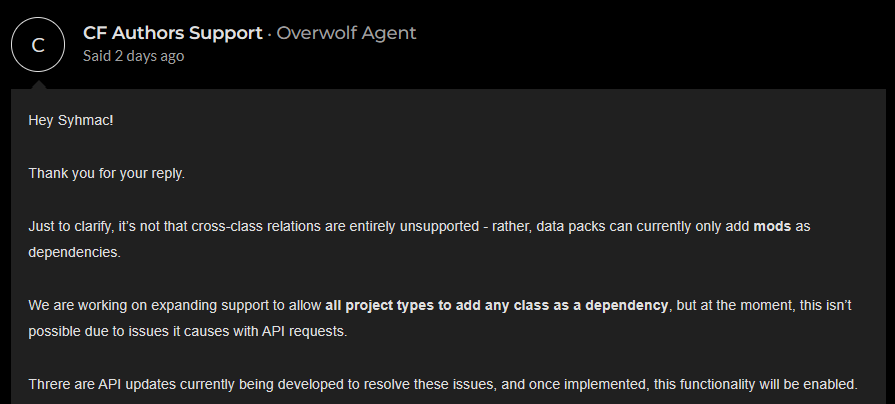
I reached out to their support and got the information that datapacks can have relations only with mods, which is just wrong. Luckily they said that they are working on a fix for that, so I hope it will be resolved soon. For those two issues, I’m giving another point to Modrinth. Currently we have 6 to 1 in a favor to Modrinth.
Additional files
Sometimes datapacks come with optional or required additional files. It can be a resource pack with optional localizations or with required assets, like textures and models.
And while it works fine on Modrinth, CurseForge doesn’t even have that option. If your datapack has any required or optional assets, you need to create separate projects and set up the relations.

If only you could set the relations… That’s obviously another point for Modrinth. 7 to 1.
Versioning and changelog
With time your projects are being updated. As a content creator, I expect to have a good system for versioning and storing the changelog. On Modrinth when you upload the file you can set its name and its version. You can also specify what changes in the update, and it will be placed at the timeline in your project’s changelog tab. This is a clear way to show users how your creation evolved over time, and it makes managing easier.

CurseForge doesn’t offer any versioning system. You must include the version number in the file name. You can specify the changelog for every release, but there is no place to see the entire timeline and users must check specific files to see what was changing over time. While this is not the most important feature, I’m still giving a point to Modrinth.
Project Icon
This is a very small issue, and I won’t be giving a point to any of the platforms for that. I have a small issue with the project icons on CurseForge, as I’m very confused about the requirements. In the project settings it says that the icon must be exactly 400×400 pixels. Although I can send my icons – which have 500×500 pixels – with no problems. So, should it say at least 400×400 pixels? I have no idea and it’s confusing me.
Donation options
Ad revenue is not the only way you can monetize your creations. Users often can support creators with donations. CurseForge offers only a limited number of options, and I don’t use any of them. You can also add only one donation method. Modrinth allows creators to provide any link to donations regardless of what you use, and you can add multiple methods. For a bit more flexibility, Modrinth is gaining another point. It’s 9 to 1 for Modrinth.
Comments
It’s time to credit CurseForge for once. There is a feature that it has, and Modrinth doesn’t. It’s a comment section under the project, where users can leave their thoughts about the creation. It’s a cool option and I wish Modrinth had it. CurseForge is gaining its long-awaited point.
Issue Tracker
I wanted to credit CurseForge again, but then I realized something. The Issue Tracker is gone! It’s only available on the legacy version of the website which CurseForge will be getting rid of eventually. This feature still isn’t available on the current website. I would give CurseForge another point if it were available outside of the legacy version.
Conclusion
And with that we concluded. It’s time to summarize the score. Modrinth wins with 9 points while CurseForge loses with only 2 points. I obviously didn’t cover the aspects that both platforms do the same – or similar enough to not make any significant difference. In my opinion Modrinth is a way better platform for content creators that offers more tools and better transparency. Of course, If I missed something, you could mention that in the comments and I will address that.
Leave a Reply